I am so grateful when someone leaves me some positive feedback on Google. You see, quite often I am asked to problem solve rather than make something straighforward. That would be easy! The designer who specifies something impossible. Someone with Granny’s fabric that looks like it’s not quite enough for the job. The lovely chair that is worn but oh-so-comfortable. The loose covers that are now in tatters. The Roman blind that isn’t behaving. Do please leave a Google review: log into your Google account and use this link: https://g.page/r/CbffjLlzPWnAEAI/review
Pelmets
I am sometimes asked to make pelmets. There are very many varieties, mostly ‘box’ pelmets, frilly affairs, swag&tails or simply boards to hide the curtain track. Except for frills, pelmets are not usually constructed to be taken down or dry cleaned – rather like your sofa, they stay in place. Pelmets are not used with poles, only with tracks.
A box pelmet is enclosed on each side and the top. It’s made from thin MDF or hardboard and attached to the wall with brackets. Inside it is lined and on the outside, there is a layer of thick interlining underneath the main fabric. If you attach your box pelmet to the ceiling, only sides and the front are needed, but if there is a cornice or your box pelmet will sit some distance below the ceiling, it benefits from a ‘roof’ or should be attached to a pelmet shelf serving the same purpose: to prevent light seepage at the top.
A frill is basically a very short curtain that covers the track, and is itself attached to a curtain track with hooks, so that you will need a double rail to accommodate your curtains and your pelmet.
A board is suitable for covering a track wall-to-wall. All you need is a suitable board and some small brackets to attach it to the ceiling. It can be covered or left as is, perhaps in a wood matching the décor.
Swags&tails are suitable for formal rooms, they need tall windows and a sufficient amount of space above it so they don’t cut out too much light.
When you plan for your pelmet, it is important to consider where your curtain ends: it should finish below the curtain rail as the pleats, especially when open, will add extra depth that needs to be accommodated in the pelmet. If the fabric has a vertical pattern it may look best to continue this from the curtain up in one continuous run to the pelmet. In that case, you’ll want to consider its pattern placement in conjunction with the curtain: the pelmet will always be visible, and the curtain will only show its full pattern when it is closed. Hence, the pelmet should show the most prominent feature of the fabric’s design.
Not enough fabric? Solution!
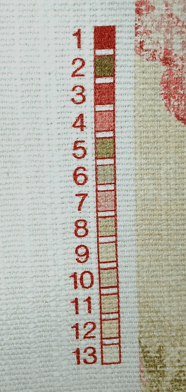
Sometimes I’m asked to produce something from a remnant. A recent case in point was when a charming lady gave me exactly 4.05 metres of fabric, thinking it would be enough for a bedspread. Alas, there would have had to be five. The fabric had been discontinued so long ago that there was no ‘deadstock’ – fabric left over in some warehouse. It’s possible to effectively overcome this by adding a contrast border in one of the colours in the pattern. Borders can be interlined with wadding, resulting in a smart, tailored solution. Similarly, this technique can be used for curtains, blinds and cushions. If you look at your remnant you’ll see all the colours used during the printing process at its edge, the ‘selvedge’.
Three-dimensional thinking
Recently, a designer specified the following for a bay window in a dining room: Make four tightly folded blinds in a semi-transparent fabric, interline them and line them with blackout lining. The blackout spec was a mystery in itself: why in a dining room? (See also below, ‘Fabric choices for Roman Blinds‘) If these blinds are pulled up, the many pleats will cause a great deal of bulk which may be acceptable in a straight window, but for windows with an inward angle, Year 8 maths might have told them that bulky blind folds on inwardly angled windows will get in the way of each other. In the end, I re-designed them all so they look smart and fit well. If you have a bay, go for a curtain.
Zahlungsmoral
“Zahlungsmoral” in German translates to payment behaviour in English, the way someone typically pays their debts or bills. When I was teaching Business, one of the early lessons was about the percentage of UK small businesses that cease trading in the first three years, which the textbook quoted as 60% – similar to 2024 statistics released by the Bank of England. Why such a high failure rate? Late payment. Now that I have been ‘The Cycling Curtain Maker’ for some time, my experience of payment behaviours is mixed. Some pay immediately, many thanks to you. Others complain to me that the banking app they use is oh-so-tricky to operate. Some, for unexplained reasons, think I should wait a few weeks. One or two have been happy to order but are then mysteriously uncontactable, so the product languishes in my workshop for weeks (the worst case of this was when something was completed in January and finally picked up in July). It’s not a big workshop, so a buildup of finished projects means I can’t begin the next one. Someone else said that things are done differently in Switzerland, so they’re not paying unless I accept their further conditions. From now on, my estimates will unfortunately require an explicit agreement to my terms, which are here.
Legal requirements
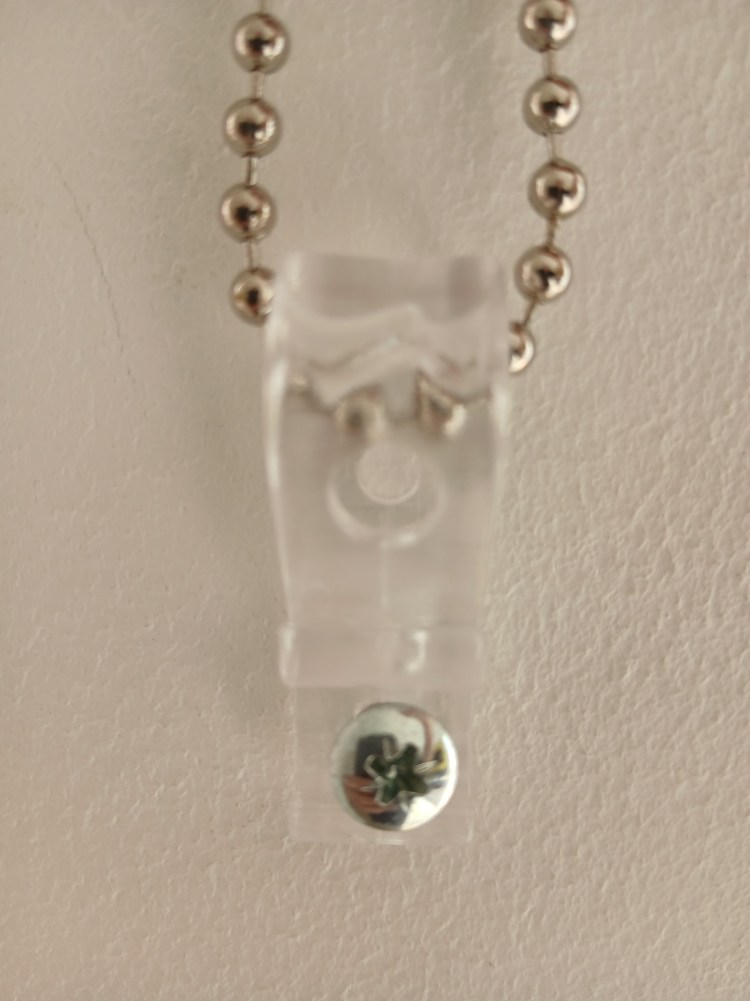
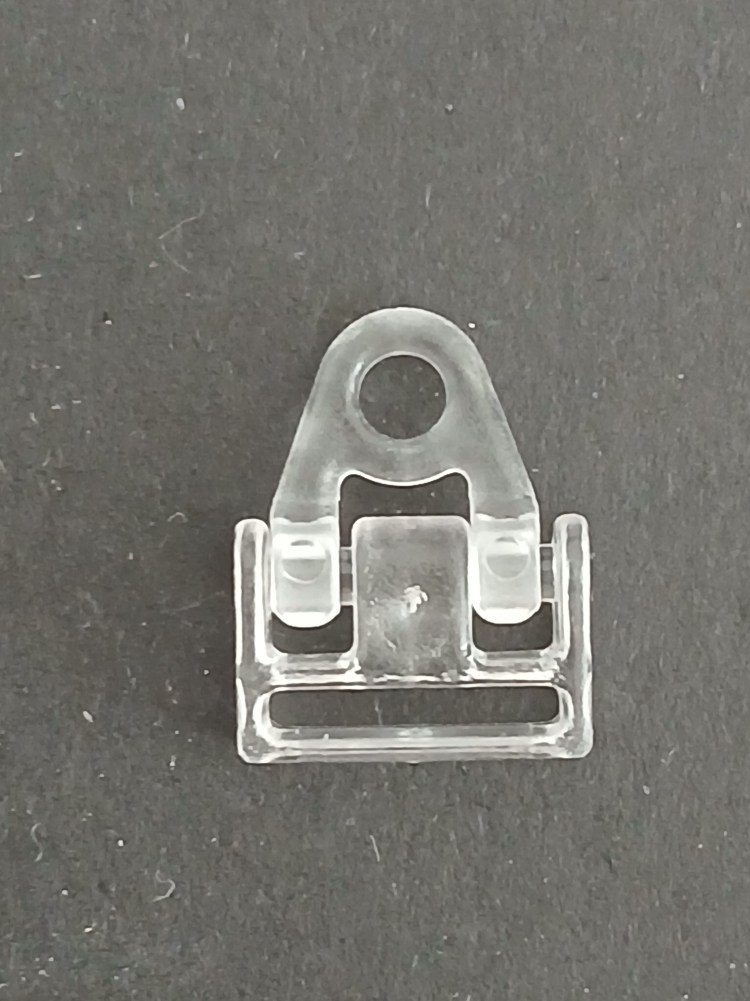
Roman blinds: there are two important considerations. Firstly, the chain of a Roman blind mechanism must be secured with a hook. This is to prevent children/cats etc. from strangling themselves. Secondly, at the back of the blind where the cords are attached to the rods, we need ‘handbag’ clips. Should someone become entangled in the cord, the clips will release and the danger is over.
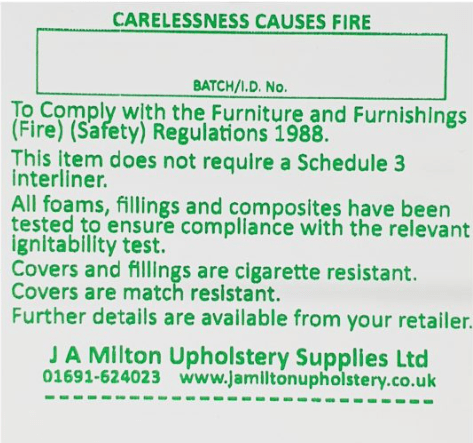
Cushions and seats: any domestic item that is an integral part of the furniture, such as loose sofa cushions, as well as all commercial work, must be fire resistant. You are entitled to see a ‘carelessness causes fire’ on the relevant item. It must be sewn in. Loose sofa cushions and curtains don’t need this.
Guardian write-up
A desire to be creative pushed Sibylle Hyde, 62, from west London, to launch her own business after retiring from teaching economics last year.
“I am a qualified upholsterer – I had taken classes since the 1990s. Since I enjoy making curtains, blinds, and upholstery, as well as cycling, I thought: ‘Why don’t I become a cycling curtain-maker?’”
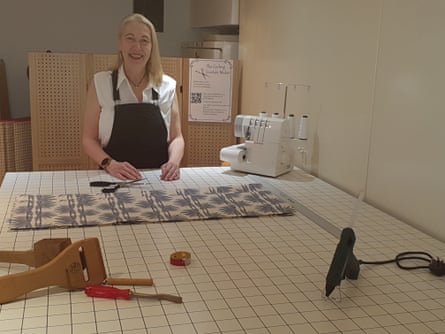
Sibylle Hyde in her home workshop. Photograph: Sibylle Hyde/Guardian Community
Hyde set up her local curtain-making business in May, dropped some leaflets in her neighbourhood and made a website.
“I have a garage and a small workshop at home, and I’ve only spent around £1,200 so far on tools: a trailer for my bike, and some Ikea table tops I clip together for very long curtains,” she said.
“It’s picking up slowly, thanks to recommendations and some repeat business. I’ve been having around £250 worth of business a week, enough for now. But if possible, I will 100% expand and hire staff.”
Despite the long hours it takes to make custom Roman blinds from scratch, Hyde is very happy with her new venture.
‘’ I’m too young for going from 100 to zero
“You need to be careful that the work doesn’t impact your health, but for me, it’s perfect, I love it. Cycling keeps me fit, and I like creative problem solving.
“I’m too young for going from 100 to zero. I’ll do this for as long as I’ll be able to, and am thinking of offering upholstery workshops for kids.”
Allergy matters
There are a few common fillings for cushions:
- Feathers and downs. They puff up well. You might be allergic.
- Wool. I have a nice British supplier for wool cushions – they are stuffed more tightly than foam or feathers.
- Foam, obviously. This is for seat and back cushion, usually wrapped in ‘wadding’ or ‘stockinette’ that stops the foam from pilling.
- Polyester. It’s the cheapest, can become a little lumpy after a while.
My Favourite Heading
It’s the best! Double pleat hand made. Why: 1. It looks elegant. But not fussy! 2. It pulls back into a small amount of space (which we call ‘stackback’) when drawn back. Handy for London. 3. It doesn’t need that much fabric, so saves money. 4. It can be adjusted accurately vertically by moving hooks in millimetre increments. 5. It’s forgiving as it looks good with lining AND interlining.
Which fabric to buy?
If you’re choosing a fabric for sitting on, such as loose covers or cushions, consider its ‘rub test’. The fabric is rubbed repeatedly on a machine to see how long it survives. A value of 60,000 is very hard-wearing. Around 35,000 – 40,000 is a good quality fabric. If you only sit on it once a year then a lower value is acceptable. With fabrics you really do get the quality you pay for, see also ‘pattern drift’ below.
Another consideration is fire safety. Domestic removable cushion covers and curtains don’t need to be fire retardant, but their fillings must be. If fabric is permanently fixed to the furniture, that also needs to be fire retardant. A label on the underside tells you whether this is the case. For example, an upholstered headboard and a drop-in seat would need to comply and have a label. For public or office spaces, everything needs to be fire retardant.
 The Cycling Curtain Maker